Diving Deep into Java: A Comprehensive Exploration of Object-Oriented Programming

What Is Object-Oriented Programming?
Object-oriented programming is a paradigm focused on objects—entities that encapsulate both data (attributes) and behavior (methods). Unlike procedural programming, which emphasizes functions, OOP organizes code around objects representing tangible concepts, such as students, employees, or products. This structure simplifies complex systems by breaking them down into smaller, self-contained units that can interact fluidly.
Exploring Classes and Objects in Java
In Java, classes act as blueprints for creating objects, defining their attributes (variables) and behaviors (methods). An object is a specific instance of a class that interacts with other objects to accomplish designated tasks.
Understanding how to effectively design and instantiate classes enables developers to create robust, modular systems that mirror real-world logic and relationships.
The Significance of Encapsulation
Encapsulation is essential for maintaining data security and integrity within Java applications. It involves grouping relevant variables and methods in a class while keeping specific details hidden from external access. By utilizing access modifiers like private, public, and protected, developers can manage how data is accessed and modified, minimizing the risk of unauthorized changes.
This principle simplifies debugging and enhances flexibility, as internal configurations can change without affecting external code dependencies.
The Advantages of Inheritance
Inheritance emerges as one of Java’s most influential OOP features. It enables one class to extend another, thereby minimizing code duplication and enhancing maintainability. For example, a Vehicle class can provide essential properties and methods that subclasses like Car and Bike can inherit and modify as needed.
Correct application of inheritance allows developers to add new functionalities without rewriting existing logic, resulting in cleaner and more sustainable codebases.
Flexibility Through Polymorphism
Polymorphism equips Java applications with flexibility by allowing a single interface to represent diverse behaviors. Through method overloading, developers can create multiple methods that share the same name but have different parameters, which improves readability. Meanwhile, method overriding allows a subclass to redefine a method inherited from its superclass for more specific behavior.
This inherent flexibility allows Java applications to adapt to shifting requirements without requiring significant rewrites of the original structure.
The Art of Abstraction
Abstraction enables developers to focus on what an object accomplishes rather than how it achieves those tasks. In Java, this is achieved through abstract classes and interfaces. Abstract classes outline common behaviors that subclasses must implement, while interfaces define agreements for classes to adhere to.
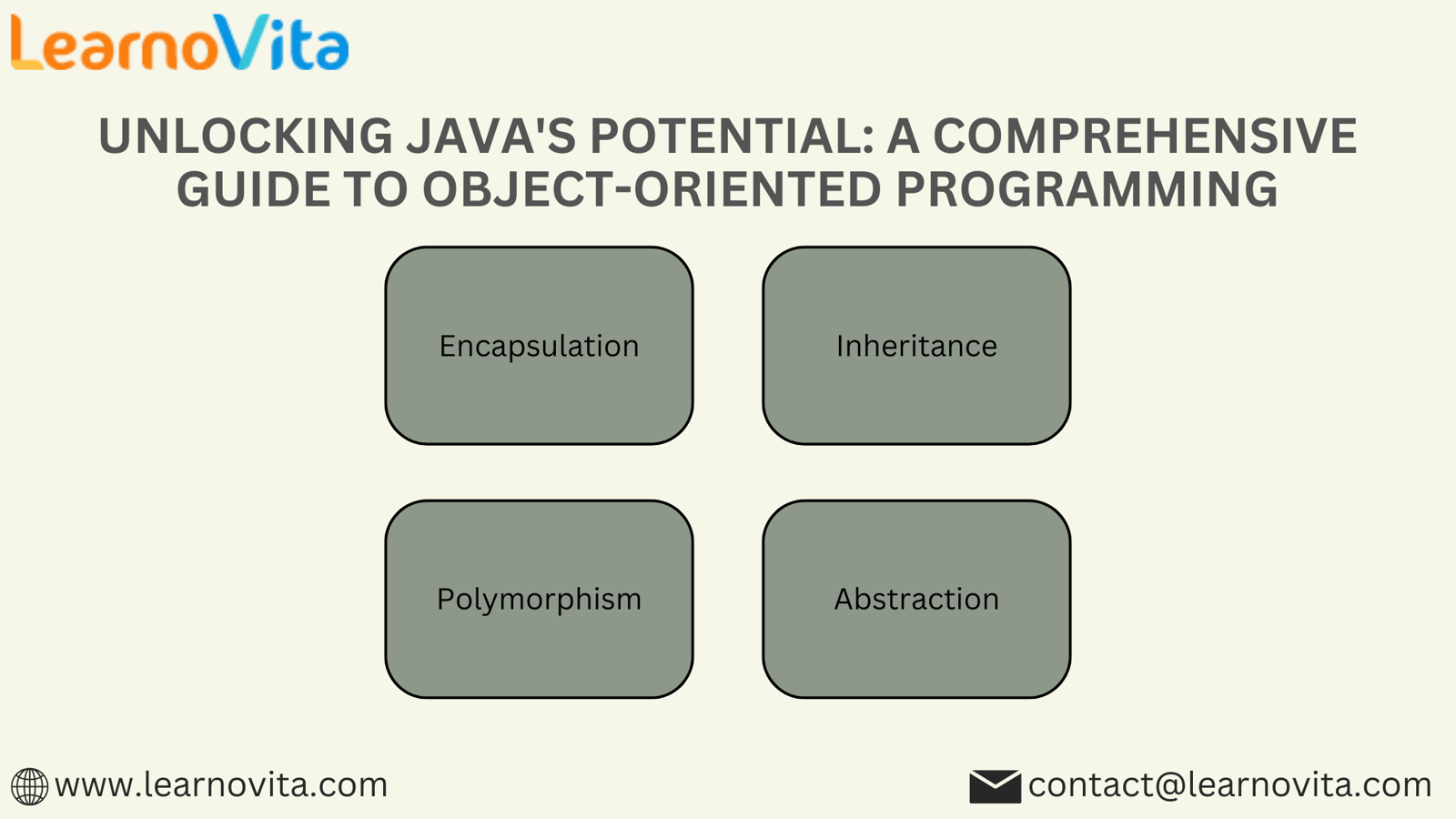
The Four Fundamental Principles of OOP
The foundation of object-oriented programming is built upon four core principles that enhance code organization, security, and reusability:
1. Encapsulation
Encapsulation involves restricting access to an object’s internal data, promoting data hiding through the use of getters and setters. This principle safeguards data security and integrity.
2. Inheritance
Inheritance allows one class to inherit the properties and methods of another, reducing redundancy and promoting code reuse. This leads to a cleaner and more maintainable codebase.
3. Polymorphism
Polymorphism provides flexibility by allowing methods to behave differently depending on the invoking object. It exists in two key forms: compile-time (method overloading) and runtime (method overriding).
4. Abstraction
Abstraction emphasizes essential characteristics while concealing complex implementation details, thereby simplifying user interactions. This contributes to clearer and more comprehensible code.
These principles serve as the backbone of how Java organizes and structures its code.
Conclusion
Mastering object-oriented programming in Java is crucial for anyone aspiring to become a proficient Java developer. By understanding and applying principles like encapsulation, inheritance, polymorphism, and abstraction, developers can build systems that are efficient, secure, and easy to maintain. OOP enhances the organization and readability of your code while facilitating scalability and flexibility—essential characteristics for modern software development. Whether you’re creating a straightforward application or a complex enterprise solution, OOP principles constitute the foundational strength of Java’s lasting power and versatility.


Comments
Post a Comment