Understanding Oracle Database Indexing: Boosting Performance and Efficiency
What is Indexing?
Indexing in the context of databases is akin to the index of a book. It provides a quick way to look up data without scanning the entire dataset. In Oracle, an index is a database object that speeds up the retrieval of rows from a table at the cost of additional space and the overhead required for maintaining the index.
How Does Indexing Work?
An index is created on one or more columns of a table. When a query is executed, the database can use the index to find the relevant rows more quickly than it could without it. Instead of performing a full table scan, which reads every row, the query optimizer uses the index to narrow down the search space effectively.
Types of Indexes in Oracle
Oracle offers various types of indexes, each serving different use cases:
- B-tree Indexes: The most common type, suitable for a range of queries.
- Bitmap Indexes: Ideal for columns with a low number of distinct values, often used in data warehousing.
- Function-Based Indexes: Built on expressions or functions, allowing complex queries to execute more efficiently.
- Clustered Indexes: Organize data rows in a way that groups related data together, enhancing performance.
- Reverse Key Indexes: Useful for applications that insert entries sequentially, reducing contention.
Benefits of Indexing
1. Improved Query Performance
The primary advantage of using indexes is faster query execution. For large tables, the time saved by making direct lookups instead of scanning all records can be significant, especially for read-heavy applications.
2. Efficient Resource Utilization
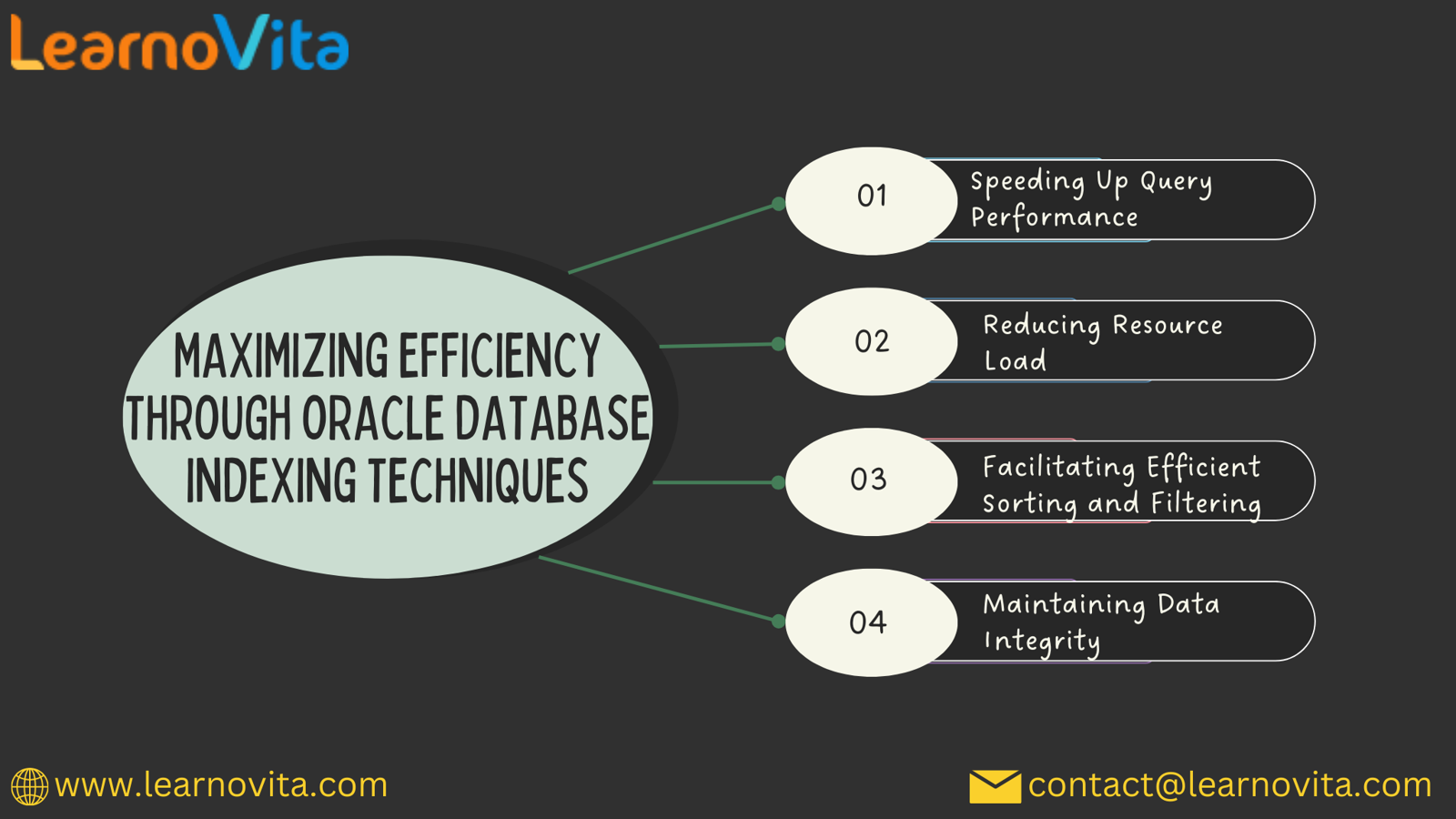
3. Enhanced Sorting and Filtering
Indexes allow for quicker sorting and filtering of results. When combined with clauses like ORDER BY or WHERE, indexes can drastically cut down processing time.
4. Supporting Unique Constraints
Unique indexes are used to enforce uniqueness on columns, ensuring data integrity. This is crucial in scenarios where duplicate values are not permissible.
Downsides of Indexing
While indexing has numerous advantages, it's essential to acknowledge potential downsides:
- Overhead: Indexes consume additional disk space. The more indexes you maintain, the more storage you'll need.
- Maintenance: Insertions, updates, and deletions can become slower because the indexes need to be updated along with the data.
Best Practices for Indexing in Oracle
To make the most of indexing, consider the following best practices:
- Analyze Queries: Use the Oracle SQL execution plan to identify slow queries and determine where indexing could be beneficial.
- Limit the Number of Indexes: Avoid over-indexing. Focus on critical columns that improve query performance the most.
- Regularly Monitor and Maintain: Periodically check index usage and rebuild fragmented indexes to maintain efficiency.
- Use Partitioning: Combine indexing with table partitioning for improved performance on large datasets.
Conclusion
In summary, indexing is a powerful tool for enhancing the performance and efficiency of Oracle databases. By understanding how to effectively implement and maintain indexes, database administrators can ensure that their systems operate smoothly, providing fast access to critical data. As with any database optimization technique, careful planning and regular assessment are key to reaping the benefits of indexing. Whether you're managing an extensive data warehouse or a transactional database, indexing can dramatically improve your workflow and user experience.


Comments
Post a Comment